

Everything You Need to Know About Human Design Type that You Won’t Find on Instagram
From Transmission to Type, the History and Quotes that Will Change How You Think About Human Design
Did you know that before there was Human Design Type, Ra created a concept called Mode? And that he didn’t introduce the four Types — Reflector, Projector, Generator, and Manifestor — until roughly ten years after he had his experience with the Voice? Did you know that each of the four Aura Types has its essence in one of the four I Ching bigrams?
I didn’t know these things at first, but when I discovered them, it deeply changed the way I interacted with the Human Design System. Since early in my journey, I’ve been searching for quotes from Ra’s lectures and books that reveal pieces and details about how the Human Design Transmission became the Human Design System.
The quotes and commentaries I share here are snapshots of turning points in my journey, marking events that irrevocably changed my understanding of the Human Design System and its purpose. As a collection, they also tell the story of how the four Types became the face of Human Design and invite you to reconsider what you think you know about the system.
In the Beginning, There Were Four Auric Forms
“ [...] my ability to be able to teach and transfer the surface was crystallized with the introduction of Type. It took me years to be able to understand what I had been told that there were four auric forms. And to be able to see how those that were interested in what I could offer them were always looking for the same answer to the same question: What can I do?” (Ra Uru Hu)
Type is a concept that Ra Uru Hu developed to convey information that words cannot express. It took him roughly 10 years to develop this concept and the formulas that go with it. Ra officially introduced Aura Type (aka Type) in 1997, roughly ten years after receiving the Human Design Transmission (HDT) through his encounter with the Voice.
In the quote above, he mentions why it took him so long to introduce Type to his students: “It took me years to understand what I had been told that there were four auric forms.” If you’ve ever had a mystical experience, I’m sure you understand how difficult it is to find the words to accurately convey what the experience meant to you and what you learned from it. Reading this quote, finding out how long it took for Ra to understand the Transmission, changed the way I understood his role in constructing the Human Design System, and it made me realize that the two are not one.
In other words, the Human Design Transmission (HDT) and the Human Design System (HDS) are two separate things. The former is something so profoundly complex that Ra spent most of his life trying to understand it, and the latter is his interpretation and translation of that information, based on his values, his perspective, his limitations, and, of course, his Design.
While Ra said the Voice informed him that there are “four auric forms,” it seems that the essential characteristics of these forms, what to call them, and how to distinguish them from each other were initially unclear. I’ll come back to this later!
Type is an Answer to a Question
The other part of this quote that captured my attention and changed the way I think about the HDS is Ra’s statement that his students consistently confronted him with the same question: “What can I do?”
Imagine encountering your BodyGraph for the first time without the concepts of Type, Strategy, and Authority, or even Profile and Incarnation Cross, to help you make sense of it. Where would you even start? I get why they asked the question. It’s a practical problem, and eventually Ra came up with a practical solution.
Type is an answer to a question; it’s a tool that gives people something to do as the transmission takes hold and they begin to gain awareness. For Ra, the ultimate point of arrival with the HDS is Passenger Consciousness, self-love, and the realization of No Choice. Ra, the sometimes-black-magician, gave the people what they wanted with Type, even if he knew it was ultimately not the point.
Before there was Type, there was Mode
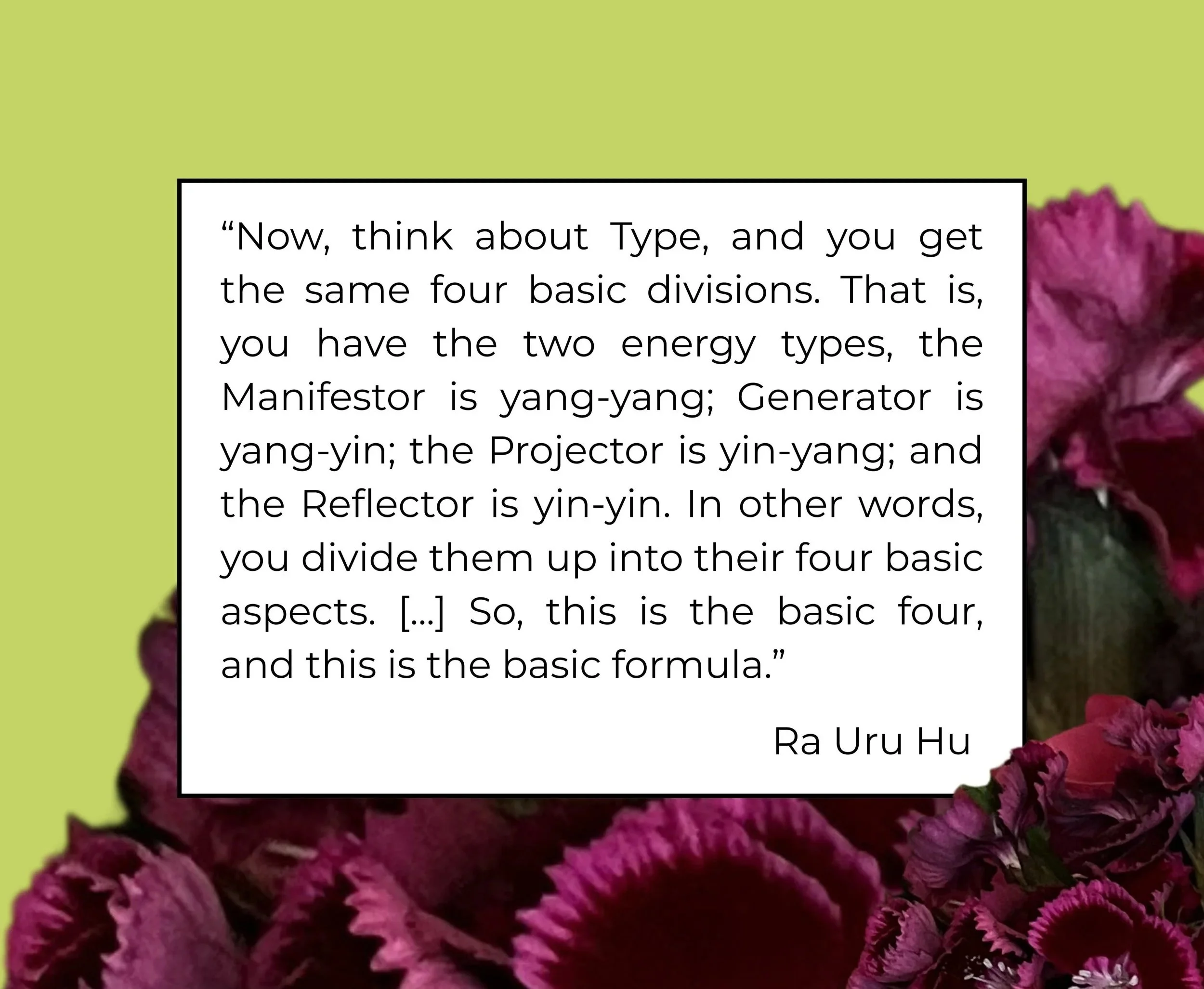
“So if you look at the zodiac according to Human Design, according to the way in which the hexagrams operate, basically the zodiac is cut into four. [...] Now, think about Type, and you get the same four basic divisions. That is, you have the two energy types, the Manifestor is yang-yang; Generator is yang-yin; the Projector is yin-yang; and the Reflector is yin-yin. In other words, you divide them up into their four basic aspects. [...] So, this is the basic four, and this is the basic formula.” (Ra Uru Hu)
The reason there are four Types in the HDS, and not five — the reason Manifesting Generator isn’t officially its own Aura Type – is because, first of all, the Voice told Ra there were four auric forms, and second, the logical structure Ra used as the foundation for his concept of Type is the four Images (or bigrams) of the I Ching.
As you can see in the quote above, Ra associated each of the four Types with one of the four bigrams. My speculation is that Ra’s roughly ten-year process of developing Type involved many years of researching the I Ching, studying the Early Heaven arrangement of the hexagrams around the wheel, and cultivating a deep understanding of the hexagram line structure. I’ll come back to this!
The Basic Formula
Before Ra introduced Type, he developed another concept to help people understand their Design: Mode. Whereas Type categorizes people into four groups based on their BodyGraph definition, Mode separates them into two categories, also based on definition, but using a different formula. These categories are Design To-Do and Design To-Wait. According to Zeno Dickson and Chaitanyo Taschler in their book Human Design Revealed, “People with designs To Do generally live out their action plans” and “having a design To Wait implies a design To Be, an internal orientation for letting life come as it does.”
The formula for Mode is based exclusively on whether or not the Design has a motor center defined to the Throat Center. If any motor, including the Sacral, is connected to the Throat via a defined channel or pathway of channels, the person is a Design To-Do. If none of the motor centers are defined to the Throat, they’re a Design To-Wait. Just as Type is rooted in the logic of the I Ching, so is Mode. However, whereas Type is quaternary, Mode is binary – it’s simply a question of yin or yang, passive or active, receptive or creative. It tells us something about the nature of the design that is different from what Type tells us.
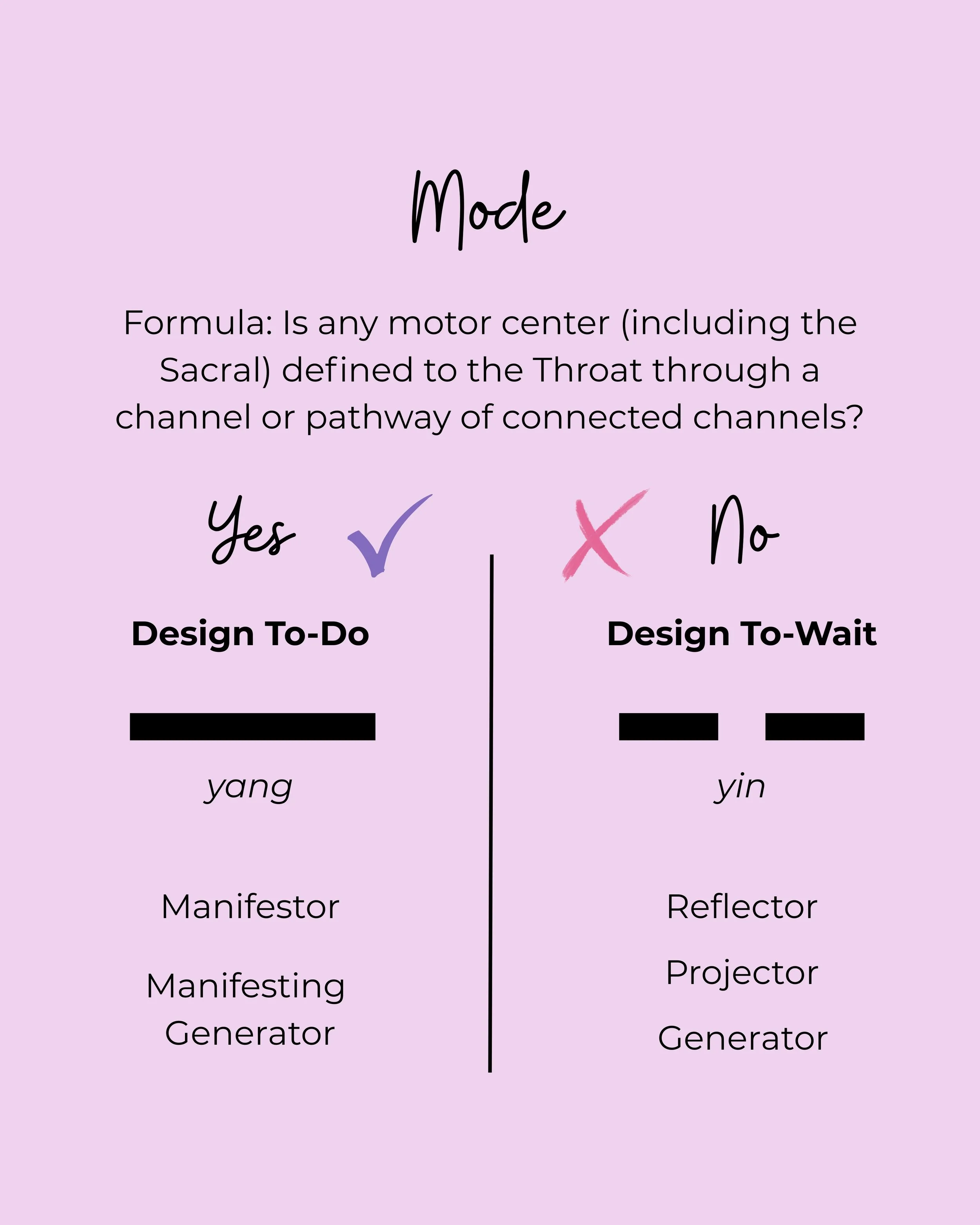
When we convert the Types to Modes using this formula, we see that Manifesting Generators are a Design To-Do (because they have a motor connected to the Throat), which explains why many MGs don’t fully resonate with the Generator characteristics or Strategy. Unlike Manifesting Generators, pure Generators are a Design To-Wait, which aligns better with the Generator Strategy of “wait to respond.”
I can’t help but consider Ra’s background in marketing here because, to me, the switch from Mode to Type was marketing genius. I suspect it contributed significantly to his success in popularizing human design. Whereas Mode divided people into two categories with a nearly 50/50 distribution, Type divided them into four categories that are distributed far more unevenly across the population, making some Types comparatively rare.
Imagine encountering human design for the first time and being told that there are roughly equal numbers of people who are Design To-Do and Design To-Wait — that there are no rare or exclusive categories with exciting labels that you might belong to. How likely would you be to submit your birth data just to discover which Mode you are? The shift to Type made for compelling marketing, whether or not that was Ra’s intention. Suddenly, people who were already exploring typology and searching for a framework to validate their sense of being different or special had a new system to try and a new label to identify with.
I’m explaining this because I want to open the possibility of returning to Mode as an option for people like me who struggle with Type. We don’t have to use every tool that Ra created. Mode may not be as exciting as Type, but it solves some of the problems Type created.
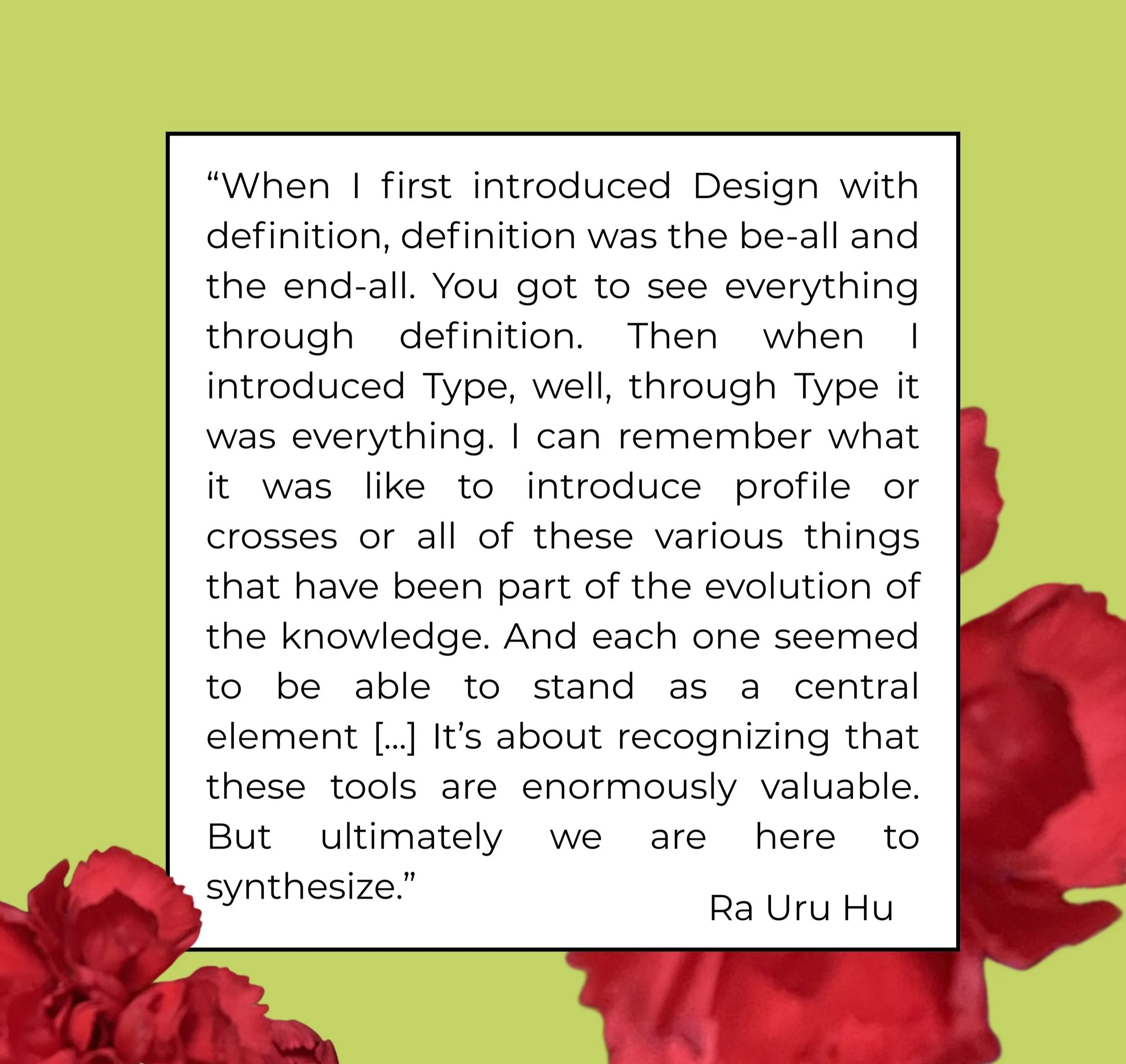
As Ra says in the quote above, the Human Design System was an evolving system. Just because he has transitioned out of form doesn’t mean the system has to stop evolving. It’s important that we keep a record of this evolution and that we continue to test the usefulness of older concepts, especially as the Global Cycle shifts, the Solar Plexus mutates, and the Raves arrive in form. Each of us who engages deeply with the Human Design BodyGraph, Rave Mandala, and Rave Cosmology is a potential synthesizer of the transmission. Which of Ra’s concepts we find useful and valuable, and which we choose to leave behind, will depend on our unique designs and perspectives, as well as how liberated we are from Outer Authority. From us, new tools and concepts will emerge. Whether or not the human design community will accept them is a different question altogether.
Not very many people realize how deeply rooted in the I Ching the Human Design System actually is. Yes, most know that the 64 gates of the BodyGraph correspond to the 64 hexagrams of the I Ching, but the connections go much deeper than this.
As Ra explains, his concept of Type is also rooted in the I Ching, in what’s called the four Images, or the four bigram arrangements of yin and yang. You can see them in the graphic below, along with their corresponding Types, according to Ra.
The Four Images and the Essence of Type
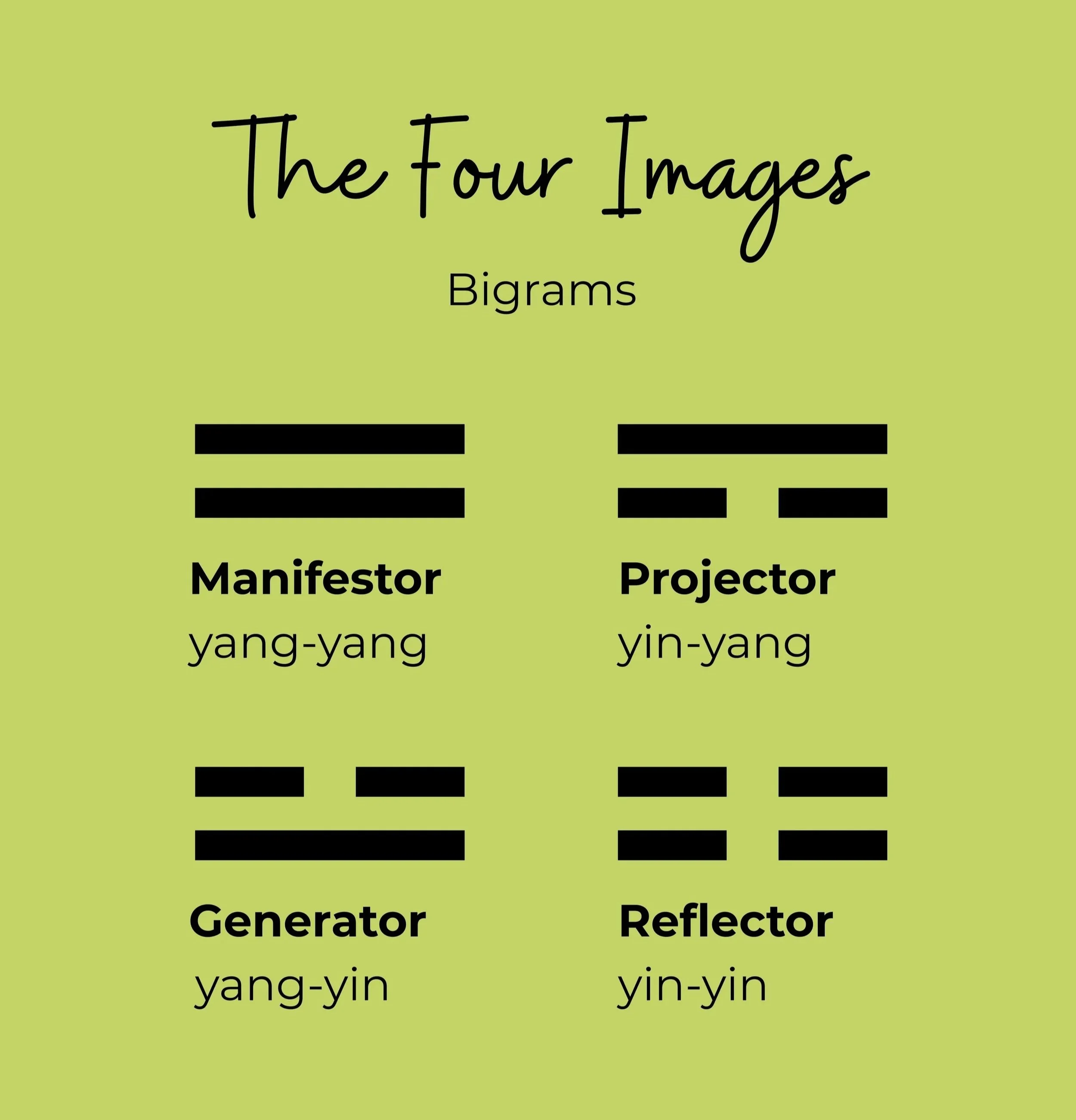
The bigrams that correspond to the two energy Types, Manifestor and Generator, both have a yang (solid) 1st-line foundation — the core quality of the aura is creative/active. The two non-energy Types, Projector and Reflector, both have a yin (broken) 1st-line foundation — the core quality of the aura is receptive/passive. Knowing this can help us make sense of why Ra calls all Projectors non-energy Types even though many of them have defined motor centers. When he uses these terms, he’s not talking about energy in a general sense. Rather, “energy type” and “non-energy type” refer to the 1st-line quality of the Type bigram — yin or yang — as part of the larger Type equation.
From here, we can look to the 2nd line of the bigram to understand the outward quality of the aura. My speculation is that Ra used the 1st line of each bigram to determine the inner quality of the aura and the 2nd line to determine the outer quality. From the perspective of the 2nd line, Projectors and Manifestors have active/creative outer auras, while Reflectors and Generators have passive/receptive outer auras. When we understand the lines of the Type bigrams in this way, we can start to see how Ra determined the aura characteristics for each Type and why he came up with words like “penetrating,” “repelling,” “enveloping,” and “sampling” to describe them.
In conceptualizing the four Types, Ra also created a unique formula for each. Below are graphics I created showing the formula, bigram structure, qualities, and name that Ra assigned to each of the four auric forms, which he presented as the four Aura Types.
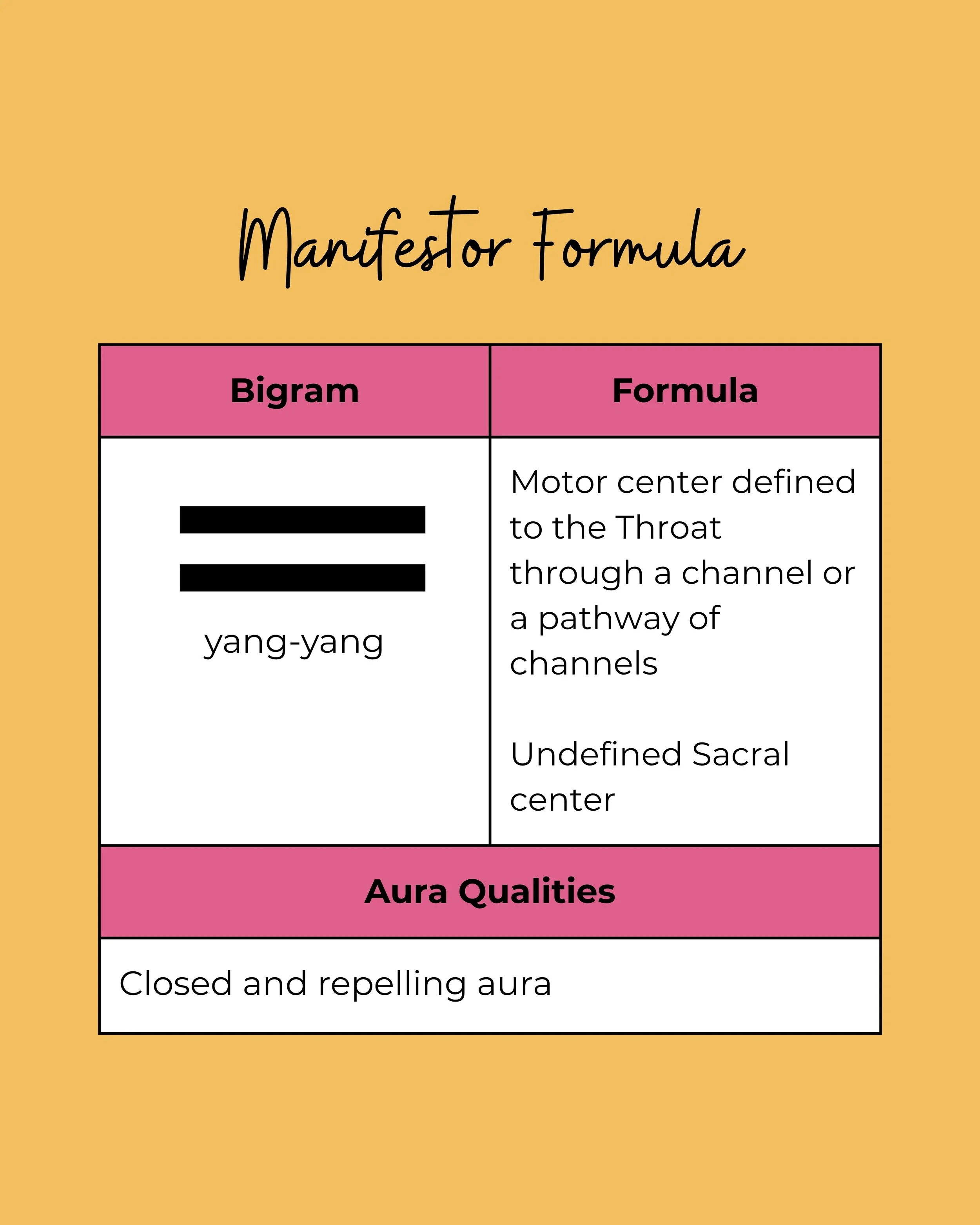
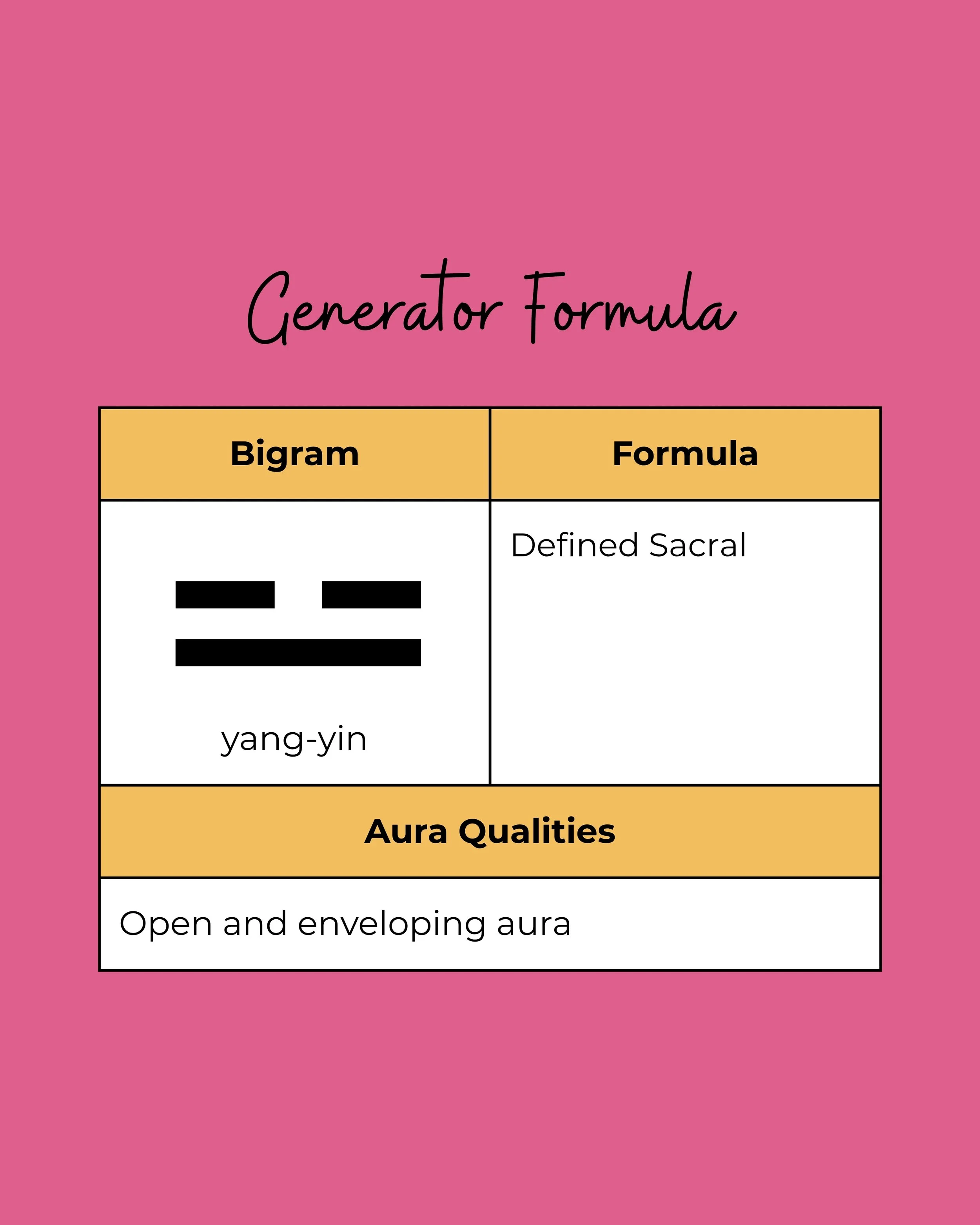
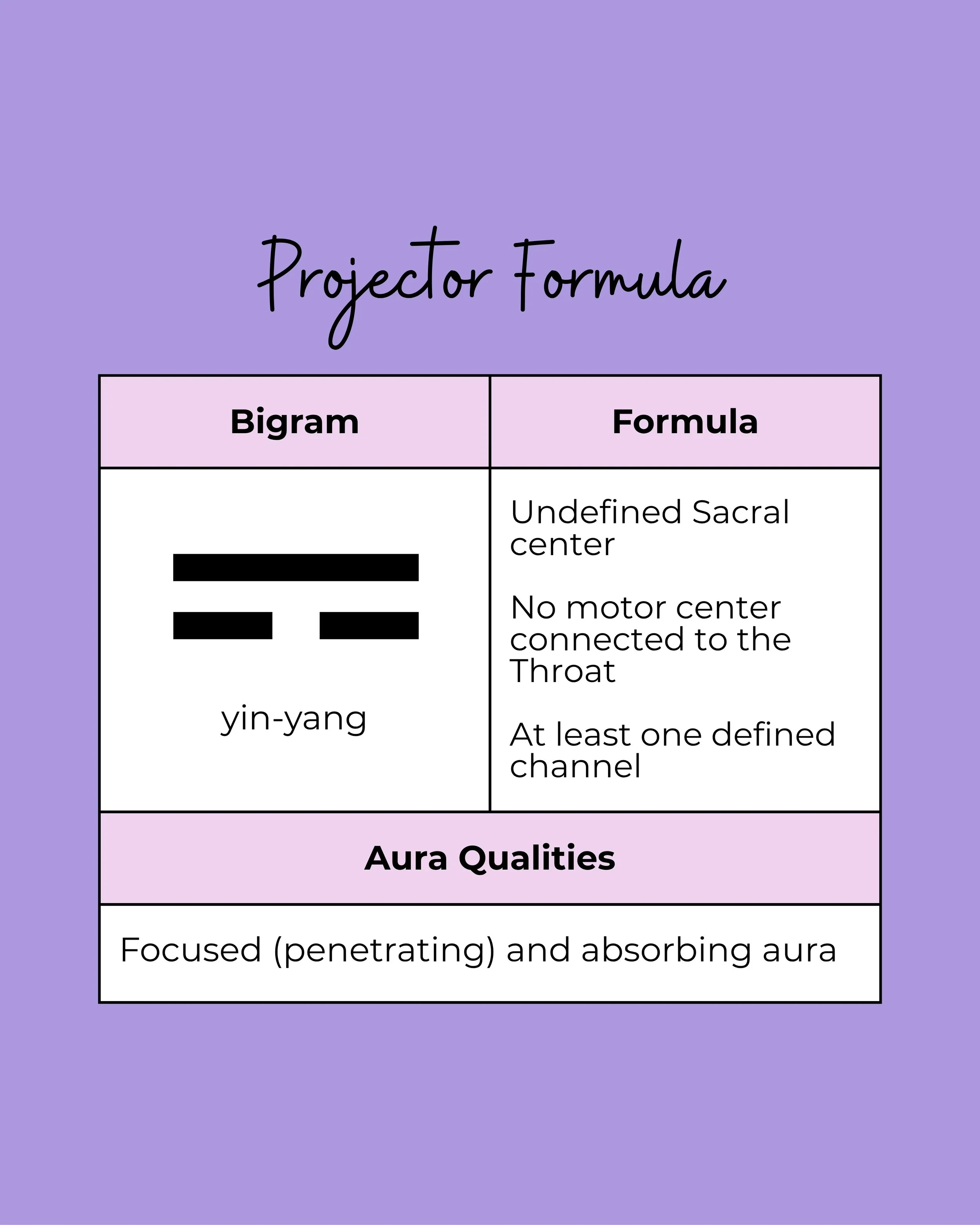
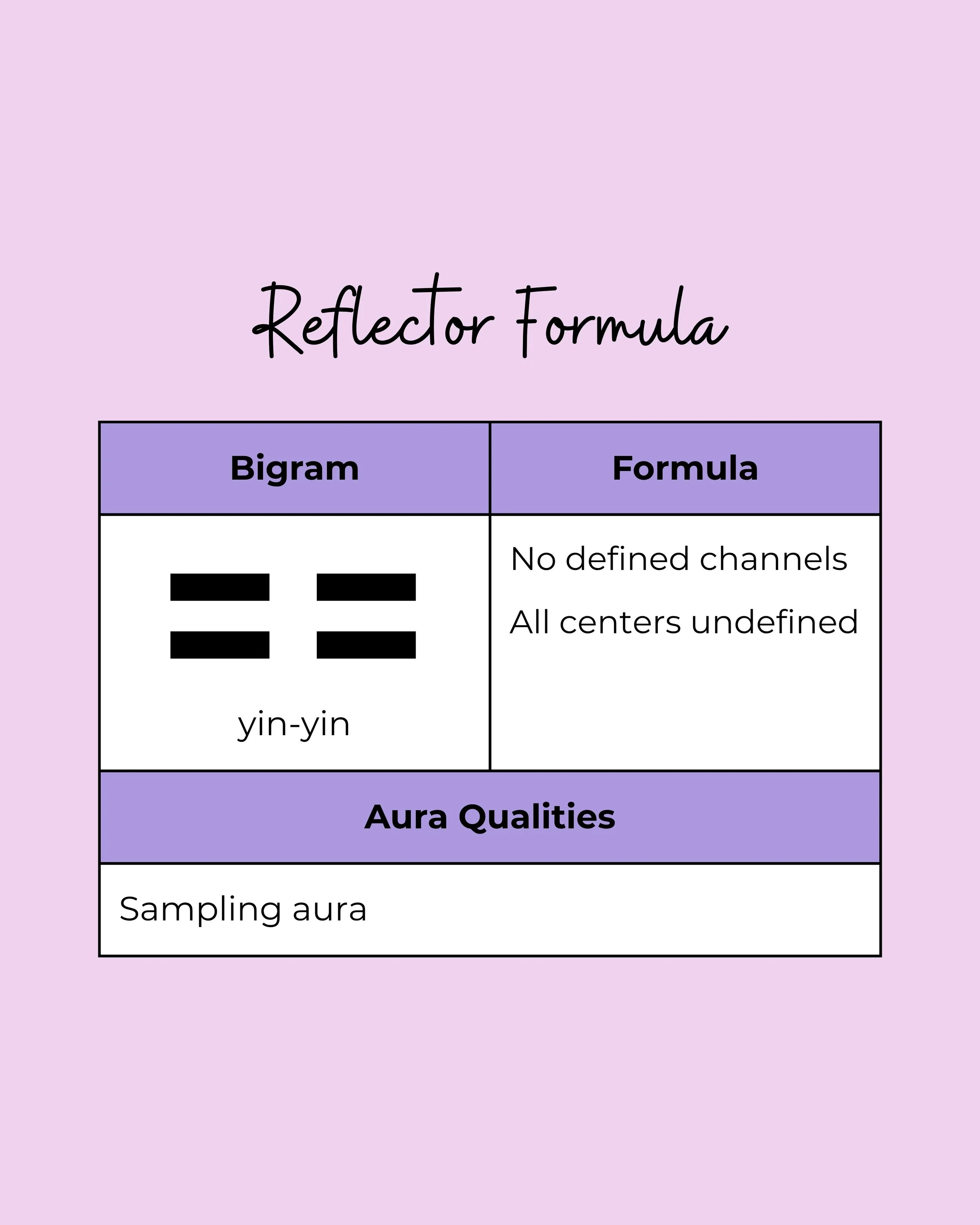
Approaching Type in this way helps us to see the traces of how the four auric forms became Projector, Reflector, Manifestor, and Generator as Ra manifested them through the I Ching matrix. Although it’s not clear how Ra developed the formulas he used to organize Designs into these Type categories, we can still reference these formulas to get a sense of how he may have moved through the process of naming the Types, assigning them characteristics, and developing their Strategies and Signatures to give people something to do with them. Once we realize that Ra had his own process developing the Types, we can begin to hold them more loosely and allow ourselves to go through a process with the information as well.
If you clear your mind of the name of your Aura Type (Reflector, Projector, etc.), its formula, Signature, and Strategy, and instead just sit with the bigram it represents, what do you experience? If you draw the bigram and contemplate its structure, what comes to mind? How do you feel? Can you loosen the grip that the concepts of Type, Strategy, and Authority have on you, and sink into the essence of your aura as represented by this bigram? Are you open to sitting with the other three bigram Images and exploring what they bring to mind and how they make you feel? The value of sitting with the bigram Images of the I Ching and contemplating these things is the possibility of a new synthesis emerging through you, a mutative experience of touching the essence of the unnamable qualities that are just outside of the grasp of words and concepts.
Through the process of contemplating the four Aura Types and their formulas alongside the four bigrams of the I Ching, we can get a sense of how Ra was able to discern some of the characteristics and qualities of each Type. And, if we’re curious enough to play a bit, we might also explore other possible interpretations. If Type-related words like “invitation,” “sampling,” “repelling,” or “work” don’t resonate with you, maybe sitting with the bigrams will bring alternative language to the surface.
The Four Quarters and the Journey of Becoming Your Type
Long before Ra developed the Human Design System, ancient Chinese philosophers arranged the eight trigrams and later the 64 hexagrams of the I Ching around the wheel in different sequences. The Rave Mandala presents the human design gates in accordance with the Fuxi or Early Heaven sequence, which is said by Hua-Ching Ni to show “the self-generating cyclic movement of the different energy phases.” (The Book of Changes and the Unchanging Truth).
Seen from a slightly different angle, astrologer and mystic Robin Armstrong explains that “the Earlier Heaven arrangement was based on natural perceptions, personal experience and astrological wisdom” (The Great Treatise: An Astrological Perspective). In his astrological commentary on the I Ching, Armstrong speculates that the Early Heaven sequence was deduced by ancient people through observing the natural cycles of Earth and our solar system: the solar cycle, lunar cycle, seasons, and more.
If we think of the wheel as representing, from one perspective, the completion of a year (the Earth’s journey around the Sun), the gates of the Ji (G) center in the Rave Mandala mark the hexagrams or places within the natural solar cycle where the seasons and relationships between light and dark change – the solstices and equinoxes. In the I Ching diagram, these changes are marked by the eight 3rd-line shifts.
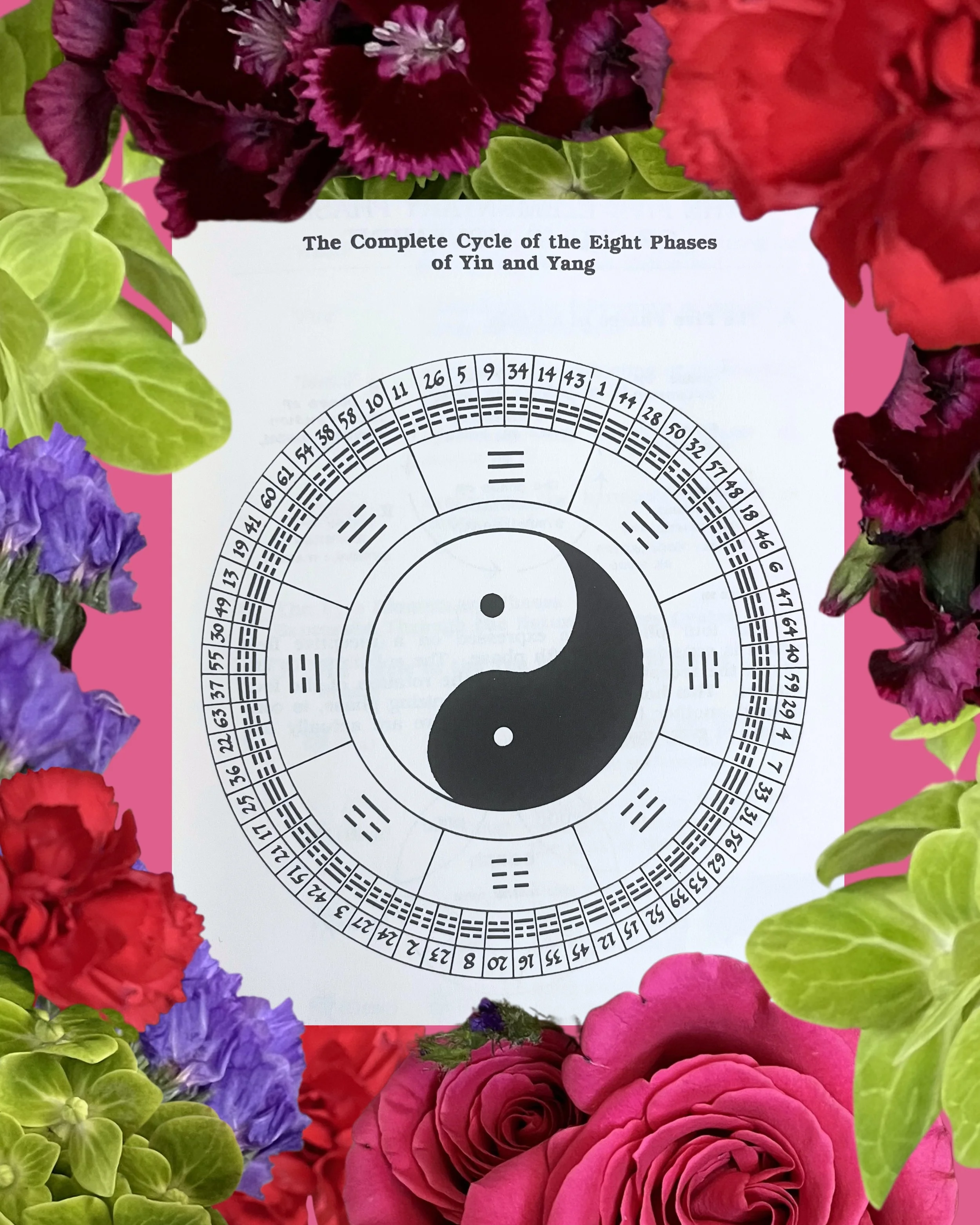
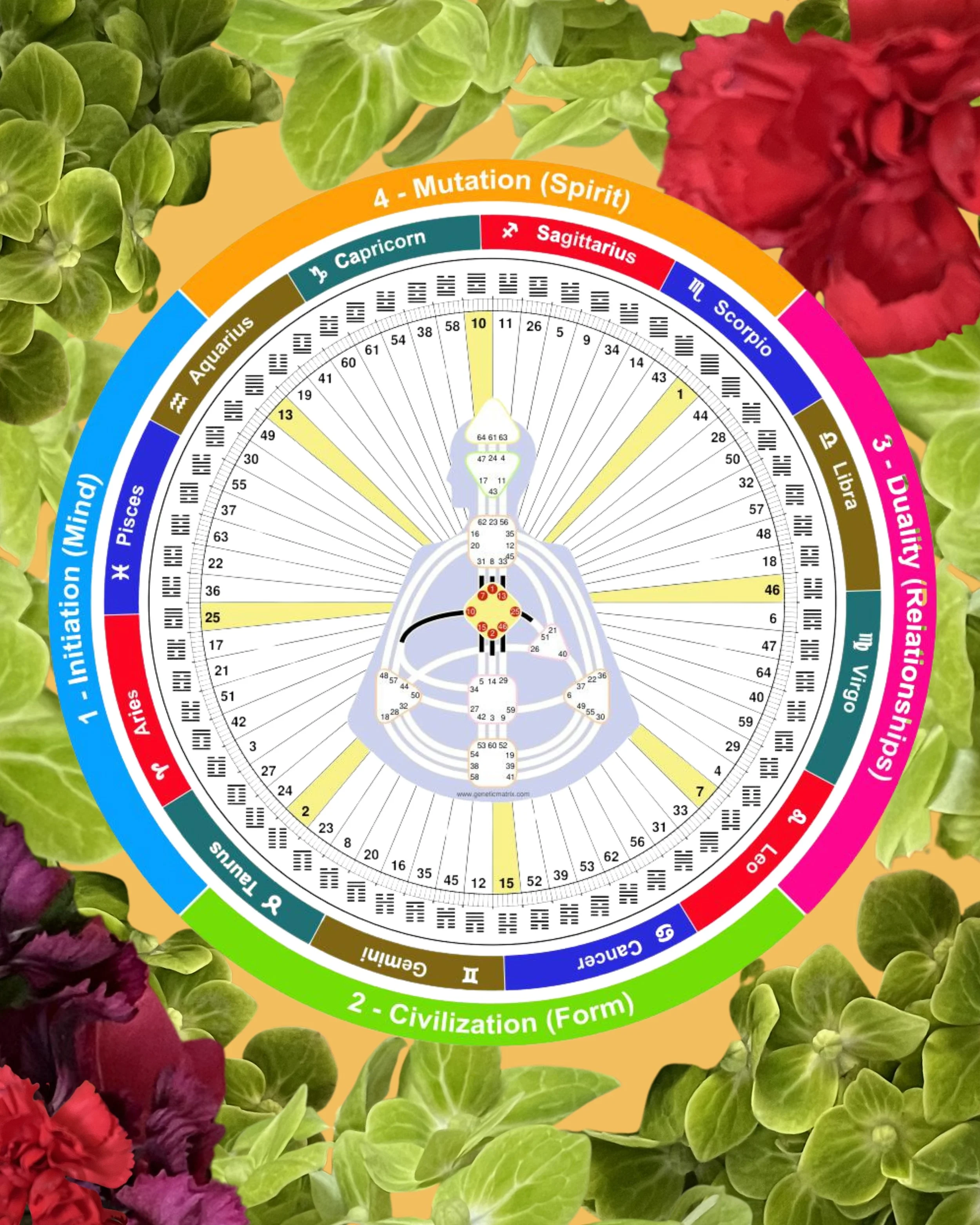
I’ve placed the two images above together so you can see the sequence is the same. To be clear, the arrangement of the gates around the Rave Mandala is not original to the Human Design System. It’s not just part of the synthesis; it’s an ancient and mystical structure, and arguably the matrix through which Ra birthed his Human Design System.
The image on the left is from Ni’s The Book of Changes and the Unchanging Truth (I Ching), and the one on the right is a Rave Mandala from Genetic Matrix. What I’m highlighting with these images is the division of the wheel according to the trigram and bigram structures. What you can see in Ni’s image that isn’t as easily legible in the standard Rave Mandala is the division of the wheel into the eight trigrams. In the Rave Mandala above, I’ve marked this division by highlighting the eight gates of the Ji (G) Center, which naturally divide it in the same way. However, what’s clearly legible in the Rave Mandala is the division of the wheel into the four bigrams, which are instead labelled as the four Quarters: Initiation, Civilization, Duality, and Mutation.
To get to the point, the four Quarters of the Rave Mandala correspond to the four bigrams of the I Ching and, therefore, also have a relationship to the four Aura Types. I’m taking us here because I want to explore whether or not the gates within the range of each of the four Quarters (bigrams) played a role in Ra’s formulation of each Type and its characteristics. My suspicion is that they did.
When I look at the gates that belong to each Quarter, specifically when I view them in their clockwise (nodal) progression, a compelling idea takes hold: in this order, the progression of gates across a Quarter seems to tell the story of the journey of the corresponding Aura Type.
For example:
The Manifestor journey from Wanting (19) to the Creative (1) (Quarter of Mutation – yang-yang)
The Generator journey from Rationalization (24) to the Listener (13) (Quarter of Initiation – yang-yin)
The Reflector journey from Privacy (33) to the Receptive (2) (Quarter of Civilization – yin-yin)
The Projector journey from Alertness (44) to the Role of the Self in Interaction (7) (Quarter of Duality – yin-yang)
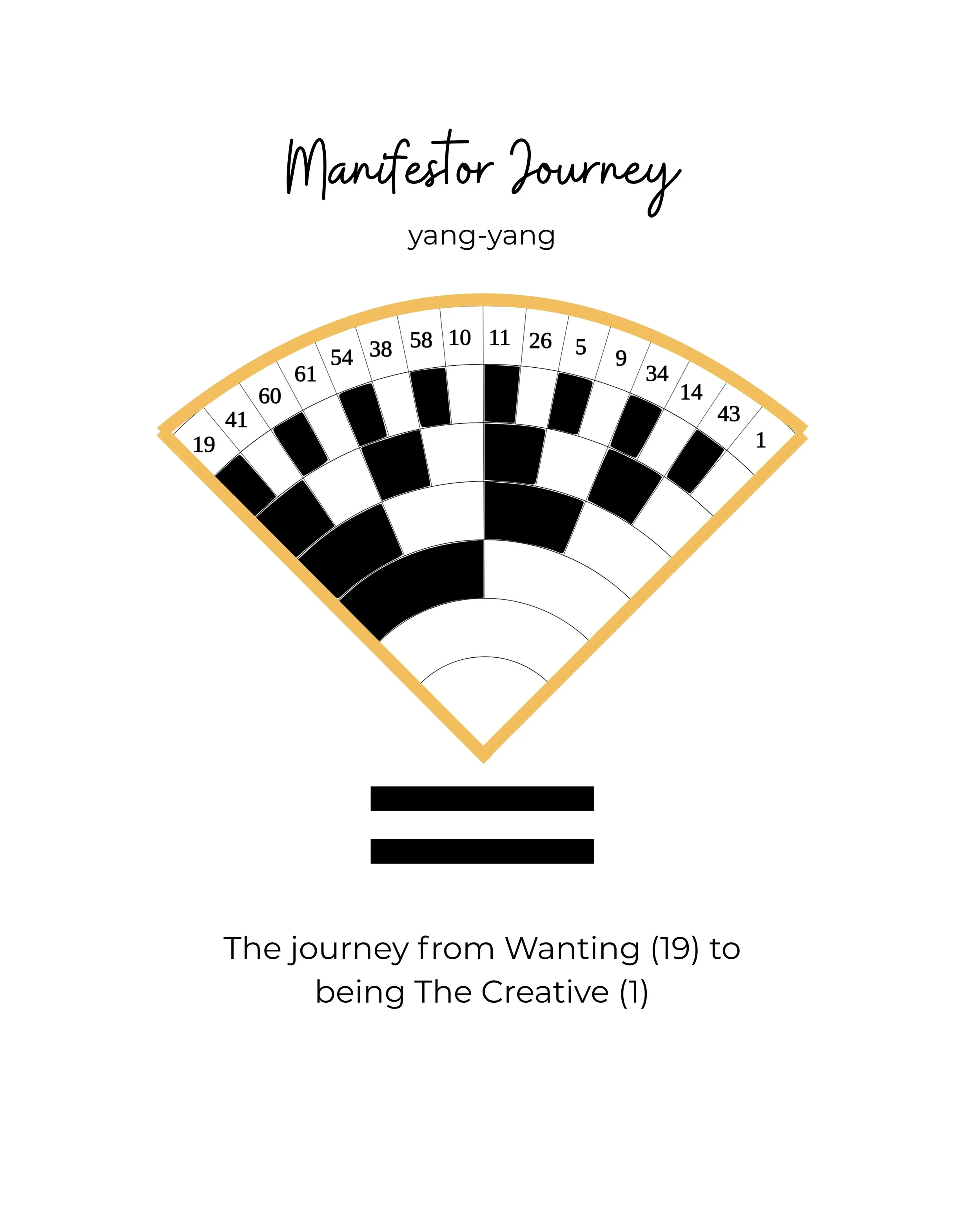
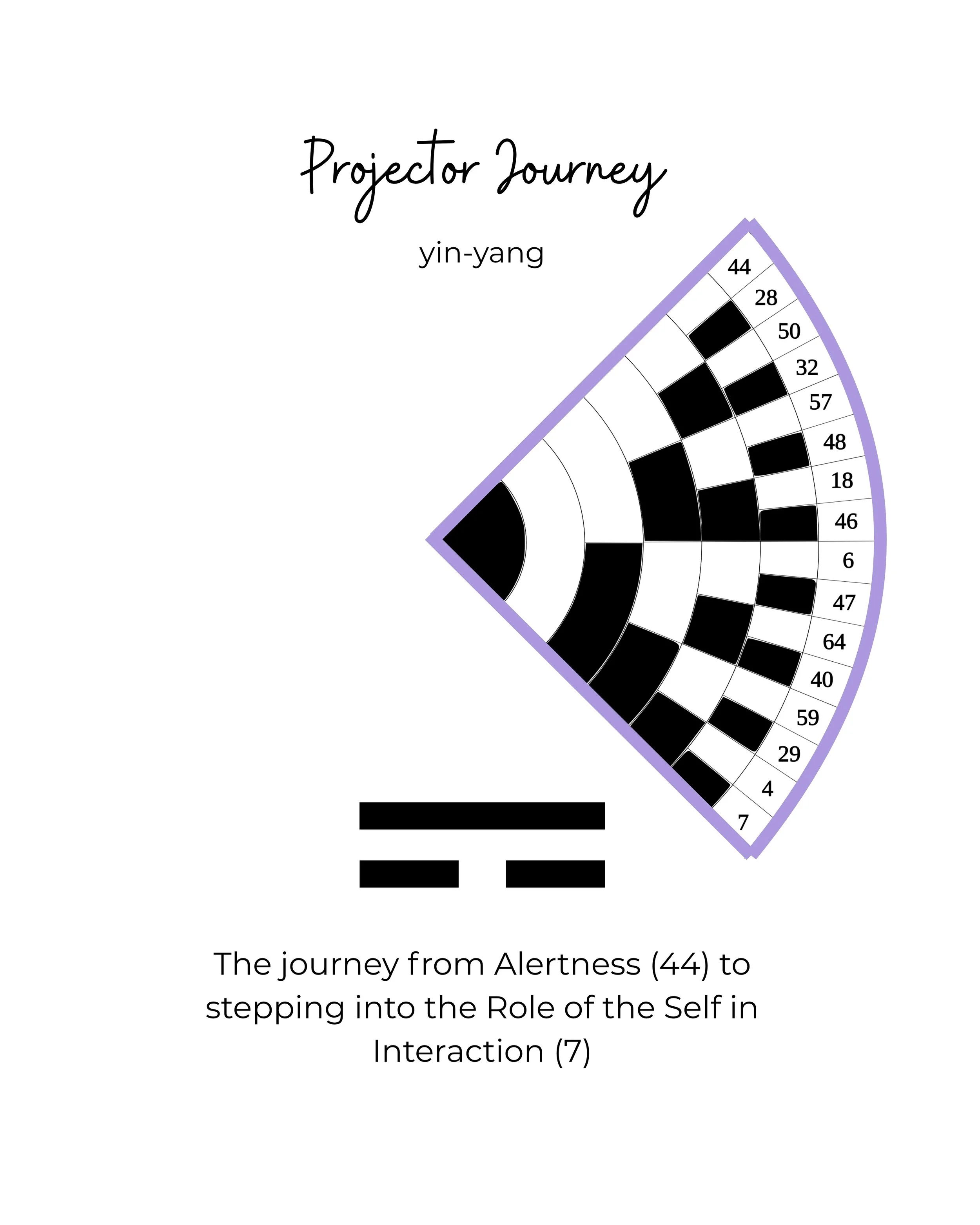
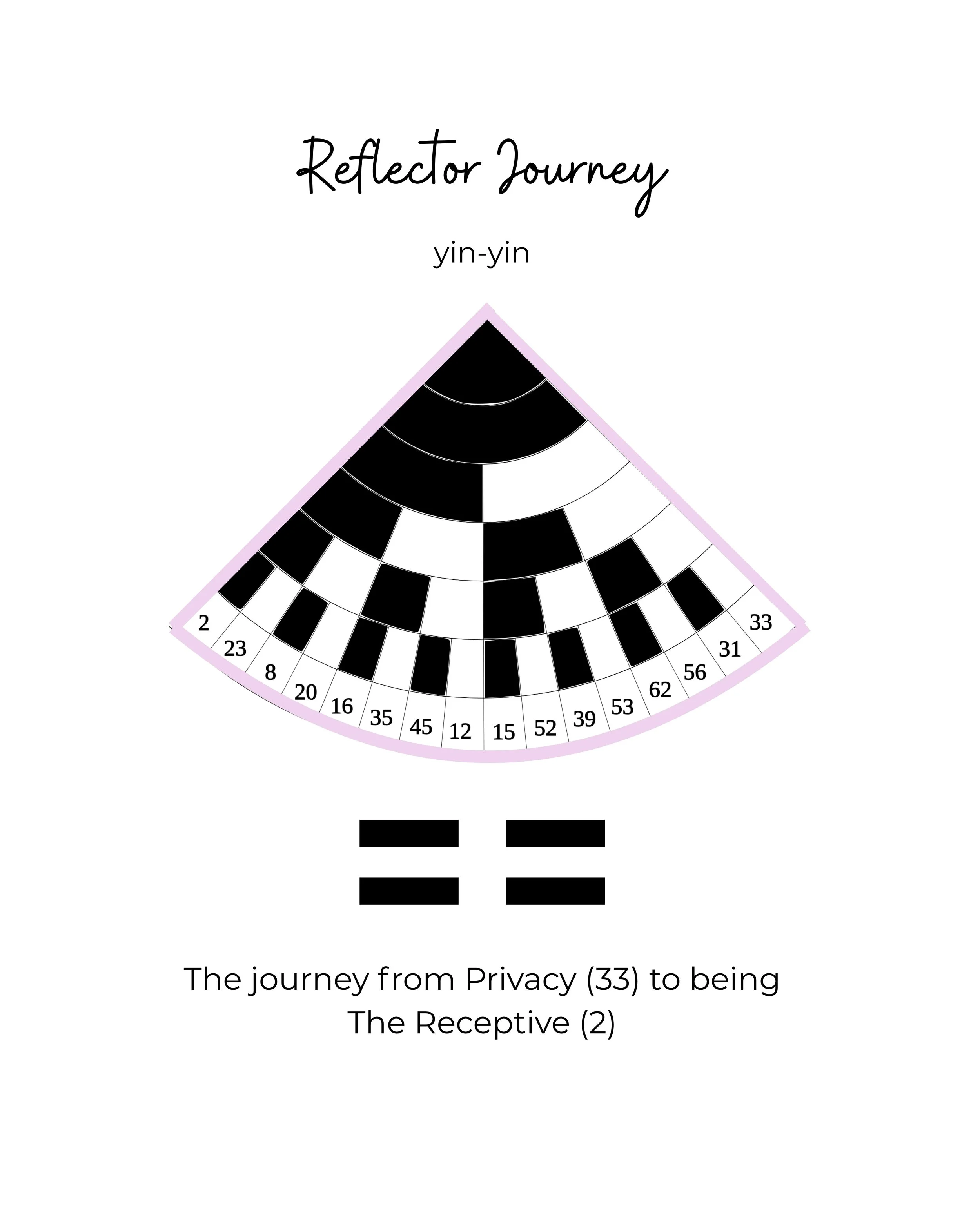
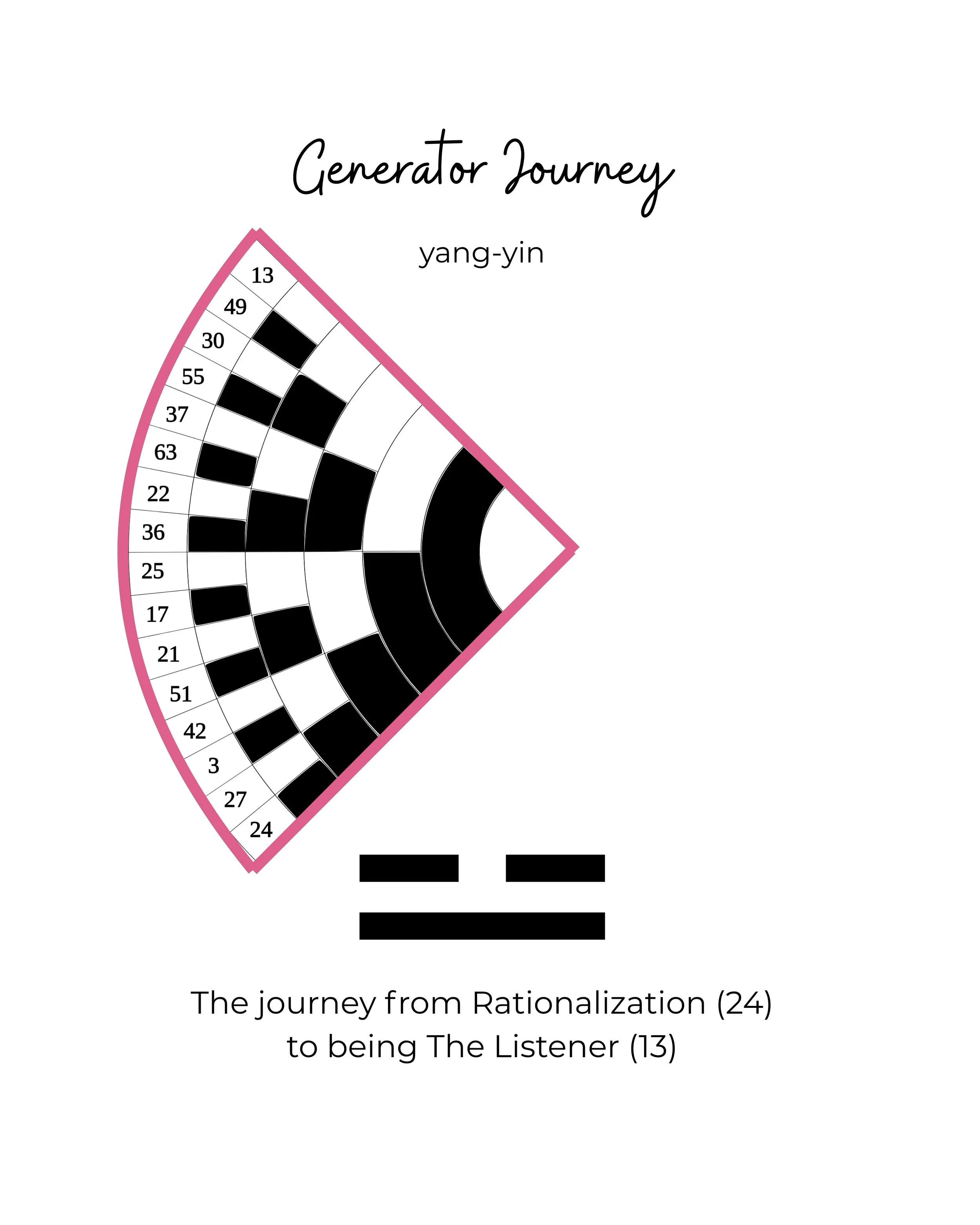
My theory is that Ra used the solar progression (counter-clockwise) of the gates in Quarters around the wheel to tell one story — the story of a generic human life unfolding with the program through time: “The witness returns through the womb, to build and bond, make more, measure and die” (Ra Uru Hu) — and he used the nodal progression (clockwise) to tell another story — the journey of each Type as they individuate and come into themselves as that Type over time.
I’m not presenting this as fact. I’m presenting it as an attempt to trace the intellectual — and perhaps spiritual — journey that Ra took to transform the four auric forms into the four Aura Types. Whether I’m right about this particular theory isn’t the point. The point is to clear a path for doing this sort of research and reparative work, and to create possibilities for better understanding how the Transmission became the System over time.
Type Functions as Outer Authority
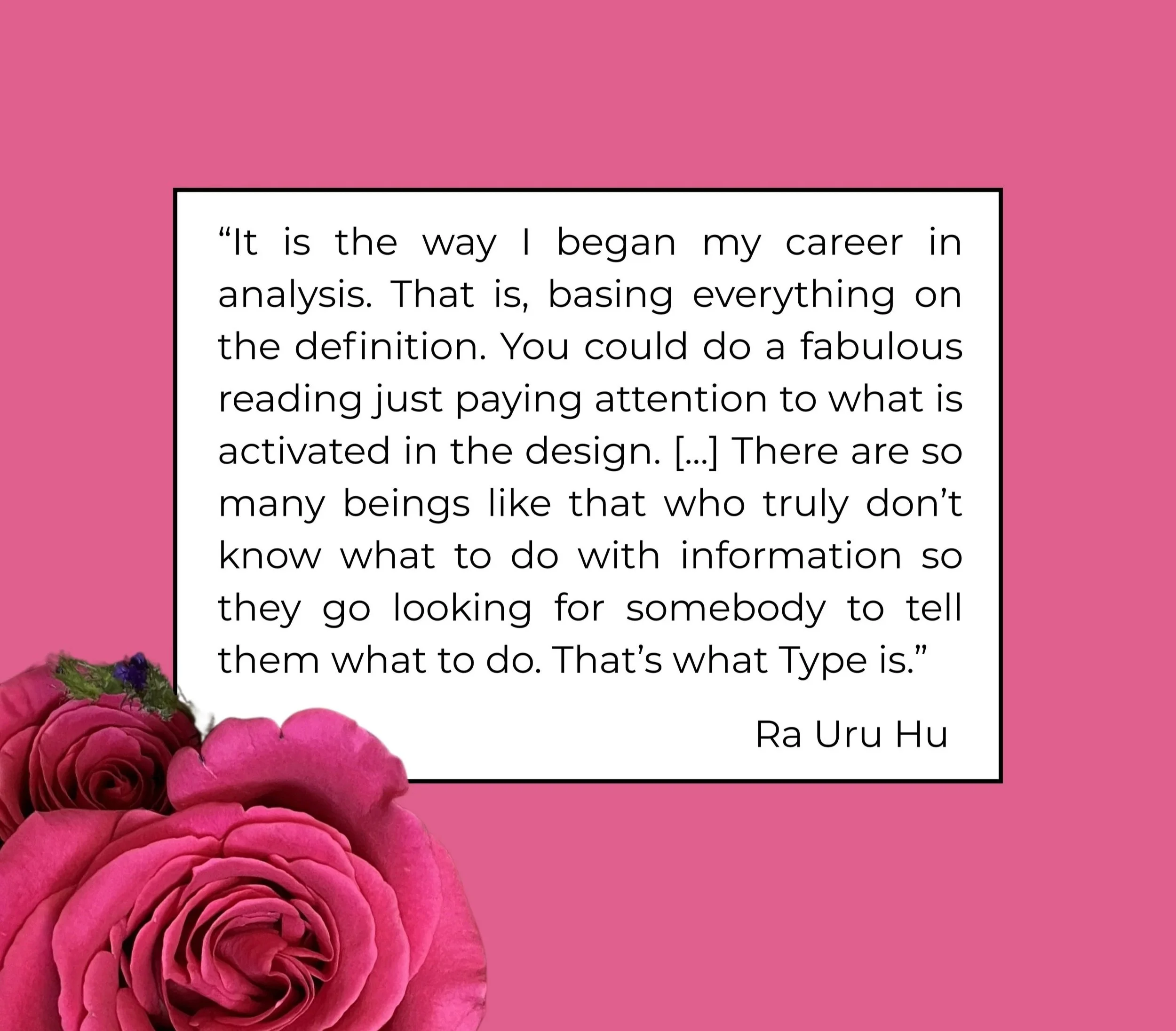
Look at the quote above! Do you see what Ra’s saying here? This is important!
He says, “There are so many beings like that who truly don’t know what to do with the information so they go looking for somebody to tell them what to do. That’s what Type is.”
Type is ultimately still a form of Outer Authority. Along with Strategy, it’s training wheels for the human design initiate who’s looking for something to do and someone to tell them how to do it.
In my opinion, part of truly awakening through the Human Design System is reaching the point where you come up against some rule, concept, or formula that doesn’t resonate, and instead of trying to make it fit (instead of accepting the system’s logic over your own Knowing), you simply trust yourself.
My Experience
One of my most profound experiences of crossing the threshold of trusting myself over the logic of the system was when an ex-boyfriend texted me a couple of years after I’d broken up with him and blocked him. The event that caused the breakup was one where I experienced deep knowing that he would physically hurt me if I continued the relationship, and so I ended it immediately.
However, when he eventually found a way to bypass my blocks and I received his message asking to reconnect, my Sacral response was one of excitement, and my body was filled with the energy of a Sacral Yes. At the same time, my Spleen delivered a firm but calm, intuitive warning: “He will harm you.”
As a Generator, the Human Design System says I should trust my Sacral Authority, and I had always had a Sacral Yes to him. Despite my Yes, I told him I was not interested in reconnecting — I trusted my Splenic Intuition over my Sacral, and I’ll tell you why.
In my design, I have the Channel of Power (34-57) defined in a constellation with the Channel of Judgement (58-18) and the Channel of Struggle (38-28). With this configuration, I often have the energy to empower others, especially those who are struggling with correcting unhealthy patterns. I’ve learned this about myself over time. With both Jupiter and Mars in my Gate 28, I’m often adrenalized by the opportunity to take big risks, empowering those who are facing profound struggles. I likely could have helped him; the energy was there.
Yet, I also have Saturn in my Gate 57, an intuitive gate that helps me sense whether or not it’s safe to move into action when faced with an opportunity to struggle or to empower others in their struggles. And, in this situation, Saturn said No, it’s not safe. Saturn shows us our limitations and asks us to be disciplined. When Saturn speaks, you listen or face the consequences.
Had I simply followed the generalized formula for how a Sacral Generator should make a decision — had I listened to my Sacral Yes — I would have interpreted my intuition as fear, and likely would have also had to face the consequences of ignoring the wisdom of my Saturn part.
Making this decision, trusting my Spleen to tell me what’s safe and what’s not safe, regardless of whether my Sacral has the energy for something, was a turning point for me in my human design experiment. It helped me realize that Ra’s concepts of Type, Strategy, and Authority are simply starting points, generalized formulas that make sense most of the time, for most people, but not all of the time, and not for everyone.
Creating Space for Individuation from the System
If you’ve listened to or read some of Ra’s advanced lectures, you know that he had a pessimistic view of what people were capable of taking in and understanding. He often emphasized that human design is only for a small percentage of people and that, even within that group, it takes seven years to go through the initiatory process of receiving and integrating the transmission via taking in your BodyGraph and the keynotes of your design. From my perspective, he underestimated people and human design.
Type, Strategy, Authority – these are all concepts that Ra created to help people who felt they needed to do something with their design. They’re Ra’s tools that he created in response to his students, based on what he thought they were capable of understanding and on what he understood himself about the four auric forms and Centers of the BodyGraph after spending ten years learning, researching, experimenting, testing, and observing them. They are not the Transmission. They are derived concepts based on translations and interpretations.
This is not to discount their value — they do serve their purpose, especially at the beginning of the human design journey. And, for the most part, I think Ra was diligent in perfecting these forms to the best of his ability before teaching them to others. If they’re working for you, great!
But if you’re a professional in this field, you should be aware that they’re not working for everyone. If your client doesn’t resonate with their Type, if they aren’t experiencing their Signature from following their Strategy, if they have a Split Definition with isolated Projected channels, if they’re a Manifesting Generator or “Energy” Projector, if they’re hearing the intelligences of multiple Centers speaking in their body, listen to them when they share their struggles and recognize the opportunity to create space for their Knowing to take priority over the logic of the system. That’s a critical part of the individuation and awakening process.
Evolution of the Human Design System
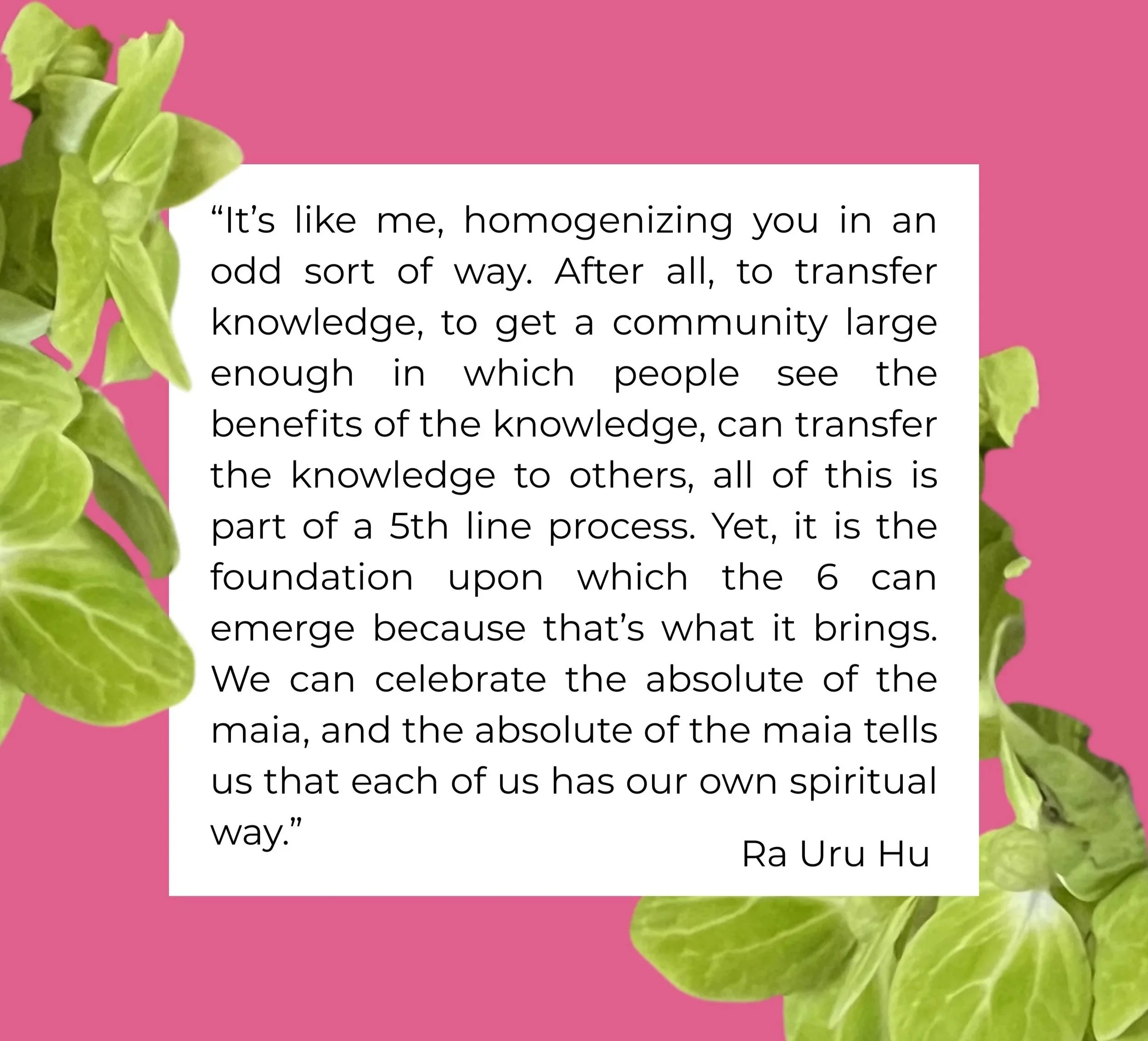
We’re quickly approaching the 2027 Global Cycle shift and movement into the 6th-line background frequency. In the quote above, Ra Uru Hu explains that his role as a 5/1 Manifestor and creator of the Human Design System was to “homogenize” us by teaching us generalized concepts that might initiate us into the awakening process; to gather us into “a community large enough” for human design to take hold in the collective; and to “transfer the knowledge” he received from the Voice in a 5th-line way. In other words, to universalize it and make it accessible to as many people as possible.
He also reveals that all of this — all of his efforts — were in service of building a foundation of knowledge “upon which the 6 can emerge.” Here he’s referencing the 6th line of the hexagram, with the keynotes “Role Model,” “transition,” “objectivity,” “separation,” and “wisdom.” It’s the top line that sees not only the foundation of the next hexagram in the sequence, but also the larger structure of the entire circuit to which it belongs. In the Profile formula, it represents a tripartite life where one must learn through trial and error before gaining wisdom and objectivity.
In my opinion, the measure of Ra’s success in accomplishing what he set out to achieve with the Human Design System will be whether or not people begin to find their “own spiritual way” and become the role models we are all meant to be in the new era, post-2027. To me, this starts with each person realizing the depth of truth that lies beyond the limitations of Ra’s 5th-line concepts — each person must realize that their aura is as unique as their design; that their true Strategy must be discovered through trial and error, observation, and experience, and cannot be handed to them by another; and that their Authority is actually multiple, complex, dynamic, and belongs only to them.
Ra’s work is done, and now it’s on us to continue evolving the Human Design System. I’d love to know where the role models are who are releasing their grip on the TSA complex (Type, Strategy, and Authority in their generalized and reductive forms), creating new tools and concepts, and doing the deeper research that allows us to make new connections between the Human Design System Ra left us with and the wisdom traditions it’s rooted in.
As for my part, I’ve been in my own wild experiment working on building tools, developing concepts, and creating practices that bring people into deeper relationship with the planets, with the wisdom traditions of the synthesis, and with themselves, using what I’ve learned on my journey to support others in finding their own spiritual way with human design.
Inspired by Robin Armstrong’s practice of chanting the hexagrams, I’ve grown my own spiritual practice of learning about the gates, channels, and centers of the BodyGraph through chanting and feeling the vibrations of the hexagram structures in my body.
Out of my frustrations with the TSA complex, I stopped using Type in a rigid way and instead began reading BodyGraphs in terms of planetary parts and defined constellations. I also developed the concept of Holistic Authority to create space for thinking about Inner Authority as multiple, non-hierarchical, and dynamic. As a 34-57, it became impossible to ignore the role my Spleen plays in my decision-making process, despite my Design being assigned “Sacral Authority.”
And then there’s the Motion Chart, a tool I created to help people visualize the electromagnetic pattern of their Design and realize the unique rhythms in their dance with the transiting planets. If you subscribe to Genetic Matrix Pro, you can find this tool as a Mandala view called “Motion.”
I don’t consider any of these rebellions against Ra or his teachings because, from my experiences of reading and listening to his lectures, these sorts of experiments are what he was calling for all along, and what the 6 is all about. I share them not as universal improvements for the collective to adopt, but as evidence of the kind of individual and spiritual evolution Ra anticipated is possible when we truly learn to love and trust ourselves above the system.
If you’re looking for a mentor to walk with you as you make your own way with human design, or as you develop new concepts and tools to contribute to its evolution, schedule a free consultation by clicking the “Book a Session” button at the top of the page, send me a DM on Instagram by clicking the icon below, or email me at Shannon@thishdexperiment.com. I’d love to talk about how I might support you!
I also want to thank Annie Hughey and Lea Artis, who let me soundboard extensively through these ideas, asked critical questions, and provided their own insights and guidance. Without their support, I would not have written this. And thank you for being here!
With love and gratitude,
Shannon Walton